The AI Agent Environment: Sandboxes, Logs, Permissions, and Verification
An AI agent is only as reliable as its environment. Learn how sandboxes, identity, permissions, logs, and outcome verification fit together.
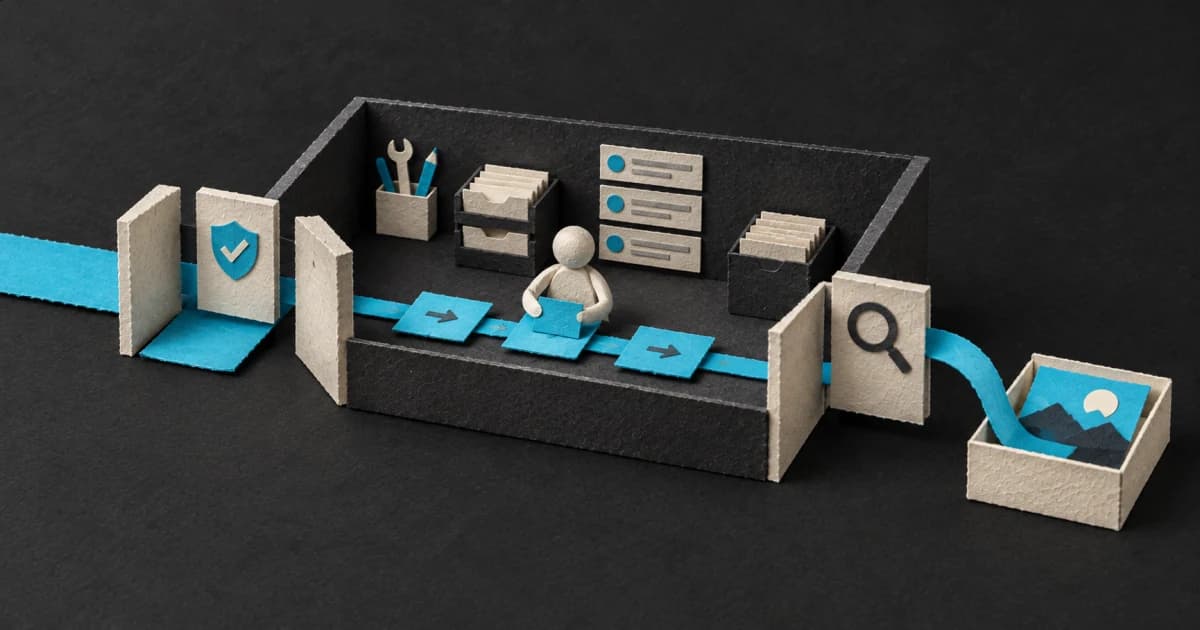
An AI agent's environment (harness) is everything around the model while work is being executed: files, terminal, browser, network, credentials, logs, and permission rules. The model can propose a strong plan, but the environment determines whether it reads the right repository, changes the right resource, and verifies the real outcome. In production, improving this environment often matters more than another prompt revision.
A sandbox is a boundary, not a punishment
An agent should not receive full computer access because it occasionally needs a privileged operation. A sandbox limits the blast radius of mistakes by constraining visible directories, network access, processes, and actions available without escalation.
The goal is not to block useful work. Give the minimum access required for the current task and route risky actions through a separate boundary. Reading project files may be routine. Publishing, deleting data, modifying production, or messaging a customer should require explicit authorization.
Identity must be observable
Many agent failures are account failures rather than reasoning failures. A command succeeds in the wrong Vercel team, the wrong Google Cloud project, or staging instead of production.
Before acting, the environment should expose:
- active account and organization,
- selected project or repository,
- branch and commit,
- target environment,
- scope of the current credential.
These values are live external state. The agent must not infer them from an earlier session or from persistent memory.
Logs should support decisions
Raw logs matter for audit, but an agent also needs a concise result: what ran, which resource it targeted, the status, and where the evidence lives. A deployment result can include its URL, deployment ID, and commit SHA. A test result can include the suite, counts, and report path.
Separate three levels:
- the command returned successfully,
- an artifact was created,
- the user can achieve the expected outcome.
A green build does not prove that the app works on a device. An upload does not prove that a file is public. The agent should state which level was actually verified.
Prefer temporary authority
Secrets belong outside repositories and prompts. If an agent needs a token, the environment can inject it into one process without revealing the value in model-visible logs. Credentials should be restricted to the relevant project and operation.
A useful pattern is staged escalation: the agent prepares a change in a sandbox, presents the diff and tests, and only an approved step receives short-lived deployment authority. The authorization boundary stays clear.
Reproducibility is part of agent UX
If success depends on an accidental tool version, a hidden local variable, or the “first available” simulator, another run can perform different work. Pin versions, select devices explicitly, and record the inputs that affect results.
OpenAI describes the broader idea as harness engineering: agent performance depends on the surrounding system that exposes code, tools, tests, and feedback. A model cannot compensate for an environment it cannot observe.
A small checklist
Before delegating an autonomous task, verify:
- the agent can see only the intended project,
- the active account and environment are explicit,
- destructive and external actions require authorization,
- secrets cannot leak into logs,
- every change produces readable evidence,
- the workflow tests the outcome, not just the command,
- tool versions and important inputs are reproducible.
An AI agent is only as reliable as the environment in which it operates. Sandboxes, logs, and permissions are not optional security accessories. They are part of the product.
Sources: